
Skip to content
CMHC Home Canada Mortgage
and Housing Corporation
  • Sign In or Register
  • Français
  • MENU
MENU
× Français
  • Home
  • Professionals
    • Project funding and mortgage financing
      • Funding programs
        • Affordable Housing Fund
        • Affordable Housing Innovation Fund
        • Apartment Construction Loan Program
        • Canada Greener Affordable Housing
        • Community (social) housing
        • Federal Lands Initiative
        • Funding for Indigenous housing
        • Housing Supply Challenge
        • Innovation and research
        • National Housing Strategy Project Profiles
        • Rapid Housing Initiative
      • Mortgage Loan Insurance Products
        • Homeowner and Small Rental Mortgage Loan Insurance
          • CMHC Second Home
          • CMHC Purchase
          • CMHC Improvement
          • CMHC Income Property
          • CMHC Refinance
          • CMHC Newcomers
          • CMHC Self-Employed
          • CMHC Portability
          • Eco Products for Lenders
        • Multi-Unit and Rental Housing
          • MLI Select
        • Default, claims and properties for sale
        • Underwriting centre
        • emili
        • NHA approved lenders
        • Calculating GDS / TDS
        • How to recognize and report mortgage fraud
        • Contact mortgage loan insurance
        • Insured Mortgage Purchase Program (IMPP)
      • Securitization
        • NHA Mortgage Backed Securities
        • Canada Mortgage Bonds
        • Canadian registered covered bonds
        • Blockchain in the housing industry
    • Housing markets, data and research
      • CMHC Reports Calendar
      • Housing markets
        • Housing market reports
        • Mortgage market and consumer reports
      • Housing research
        • Consultations
          • Prohibition on the Purchase of Residential Property by Non-Canadians Act
            • Prohibition on the Purchase of Residential Property by Non-Canadians Act – Frequently asked questions
        • Housing research reports
        • Housing surveys
          • Mortgage consumer surveys
        • Research awards and scholarships
        • Understanding core housing need
        • Collaborative Housing Research Network
      • Housing data
        • Data tables
          • Household characteristics data
          • Housing market data
          • Mortgage and debt data
          • Rental market data
        • Housing market information portal
        • Residential Mortgage Industry Data Dashboard
        • CMHC licence agreement for the use of data
        • Housing Knowledge Centre
    • Industry innovation and leadership
      • Housing innovation
      • Our Partners
        • Partnerships
        • Federal, Provincial and Territorial Forum on Housing
      • Industry collaboration
        • Expert Community on Housing (ECoH)
      • Industry expertise
        • Affordable housing
        • Indigenous housing
        • Senior housing
        • Accessible and adaptable housing
        • Developing sustainable housing
        • Resources for mortgage professionals
        • CMHC Housing Updates
    • Events and speakers
      • Conferences
      • Speakers’ bureau
        • Speakers’ Bureau request form
  • Consumers
    • Buying a home
      • Homebuying calculators
        • Mortgage calculator
        • Affordability calculator
        • Debt service calculator
      • Buying guides
        • Homebuying Step by Step: Guide and Checklist
        • CMHC's condominium buyer's guide
      • Mortgage loan insurance for consumers
        • What is CMHC mortgage loan insurance?
        • Do I qualify for mortgage loan insurance?
        • CMHC mortgage loan insurance costs
        • CMHC's Eco Products
          • CMHC’s Eco Improvement
          • CMHC Eco Plus
        • CMHC — home renovation financing options
        • FAQs — mortgage loan insurance
      • Incentives for homebuyers
      • Newcomers
      • The First-Time Home Buyer Incentive
    • Owning a home
      • Manage your mortgage
        • Mortgage fraud
        • Mortgage planning tips
        • Plan and manage your mortgage
        • Your credit report
        • Your home value
      • Aging in place
        • Housing options for Seniors
        • Housing and finance tips
        • Mortgage financing options for people 55+
        • Preventing fraud and financial abuse
    • Renting a home
      • I want to rent
        • Things to consider before renting
        • Types of housing for rent in Canada
        • Finding or advertising a rental property
        • Visiting the rental property
        • Lease and rental agreements
        • Signing the lease
        • Credit checks and bad credit
        • Rental payments and deposits
        • Roommates and pets
      • I am renting
        • Moving day
        • Landlord/Tenant responsibilities
        • Inspections
        • Maintenance and repairs
        • Complaints and evictions
        • Rent increases
        • When you can't pay rent
        • Renewing or terminating the lease
        • Moving out
      • One-Time Top-Up to the Canada Housing Benefit
  • About CMHC
    • CMHC’s goals, values and commitment to housing
    • Discover Life at CMHC
    • Management and governance
      • Speakers’ bureau
      • CMHC's Annual Public Meeting
      • CMHC’s board of directors and committees
      • Our management committee
      • Pension governance
        • Pension overview
        • Key roles and responsibilities
        • Annual reports
    • Corporate reporting
      • CMHC’s 2024 Annual Report
      • Program evaluation
      • Quarterly financial reports
      • Joint auditors special examination report to CMHC board 2018
      • CMHC’s Insured Mortgage Deferral
      • Corporate Plan Summary
      • Transparency
        • Access to information and privacy protection
        • Accessibility at CMHC
        • Accessibility feedback process
        • Briefing materials
        • Procurement
          • Vendor Diversity Program
        • Travel, hospitality and conference expenditures
    • Contact us
      • Contact mortgage loan insurance
      • Indigenous and the North Housing Solutions
      • National office
      • Regional offices
      • Granville lsland
      • Holiday service hours
  • Media Newsroom
  • National Housing Strategy
    • What is the strategy?
      • About the initiatives
      • How to apply
      • Help and resources
      • The National Housing Strategy Glossary of Common Terms
    • Federal/Provincial/Territorial housing agreements
    • Other funding and financing opportunities
  • The Housing Observer
  • Canada’s Housing Podcast
  • Success stories
  • Careers
  • Housing Knowledge Centre
 
  • Home
  • The Housing Observer
  • Modular housing factory increases supply for Canada’s North
  • Save
  • Share

Modular housing factory increases supply for Canada’s North

From Manitoba to Nunavut, innovative solution supports construction jobs, training in southern Canada and new homes in the North.

Save Icon

SAVE TO MY FOLDER

Modular housing factory increases supply for Canada’s North

SAVE
Close this Window   |   Manage my Folder
Save Icon

SAVE TO MY FOLDER

Modular housing factory increases supply for Canada’s North

Done Done!
Close this Window   |   Manage my Folder
Share icon

Share via

  • Facebook
  • LinkedIn
  • Mail
  • print
  • CopyLink

SuccessCopyLinkVersionLink copied

Share icon

Share via

  • Facebook
  • LinkedIn
  • Mail
  • print
  • CopyLink

SuccessCopyLinkVersionLink copied

share icon

Mail-blue Share via Email

Did You Know?

You can include an email signature?

Register | Sign In

×
Google Captcha Loader
share icon

Mail-blue Share via Email

Done Done!
Close this window

April 24, 2026

Your browser does not support the video tag. Transcript

00:00:00:00

[Audio: Adventurous music plays.]

[Visual: The sun shines behind fluffy clouds over train tracks in the countryside. The tracks lead past a lot with a factory and several modular homes. A cargo ship sails towards a hamlet in the North. A vehicle drives on a dirt road alongside the shore. A person drives an ATV across the tundra. Amanda Doiron, a woman with brown bobbed hair, sits in an office.]

00:00:02:00

[Speaker: Amanda Doiron, Co-founder, Arctic Modular Homes]

When it comes to Canada and housing needs, unfortunately, Nunavut and the northern provinces are the ones that are being left behind.

00:00:12:00

[Visual: Stuart Rostant, a grey-haired man with a short beard, watches a modular home being hauled out of the factory. Later, he sits in front of a row of partially built modular homes in the factory. A truck hauls modular homes on a flatbed trailer. Stuart and three men, all wearing reflective vests, talk at a worksite in the North. Snow falls on a frozen arctic landscape.]

[Speaker: Stuart Rostant, Co-founder, Arctic Modular Homes]

There are so many difficulties around capacity, transport, logistics of building in harsh winter climates.

00:00:20:00

[Visual: Stuart examines blueprints on a computer in the factory. Amanda works on a computer and takes a call in the office. Stuart uses a nail gun to attach plywood to a metal frame.]

[Speaker: Amanda Doiron, Co-founder, Arctic Modular Homes]

Cost, the extra resources you need, the lack of resources that are there when it comes to material, to labour.

00:00:27:00

[Visual: A truck hauls a modular home alongside a bay. Stuart directs workers in a construction vehicle and on the ground. The truck driver speaks with Amanda on a cleared lot. A forklift carries a modular home away from two rows of similar modular homes. Four rows of modular homes sit in front of a bay, where a cargo ship floats near a barge. Several vehicles escort a truck hauling a modular home towards a hamlet. Amanda sits in the office, crosses her arms and smiles. Stuart sits in the factory and stares forward confidently.]

[Speaker: Stuart Rostant, Co-founder, Arctic Modular Homes]

How do we go from installing 1 home to 9 homes to 22 homes spread across Nunavut? We need 3,000 homes yesterday in Nunavut, and so it’s kind of an all-hands-on-deck approach.

[Visual: A rapid montage of the steps to build a modular home and transport it to a northern community plays. In front of the factory, white text reads, “The Long Journey Home - Building Modular Homes for Canada’s North.”]

[Audio: Upbeat music plays.]

00:00:48:00

[Visual: Amanda types on a keyboard and later sits in her chair at the edge of her cubicle. A text box that reads “Amanda Doiron, Co-founder, Arctic Modular Homes” appears briefly.]

[Speaker: Amanda Doiron, Co-founder, Arctic Modular Homes]

My name is Amanda Doiron, and I’m one of the principals at Arctic Modular Homes. The team at Arctic Modular Homes is myself and my husband, Stuart Rostant.

[Visual Amanda and Stuart talk while looking at a blueprint on a computer screen. The couple smiles in a photo from earlier in their relationship. Children play and fish on a dock. A palm tree trembles in the wind. Waves roll onto a beach bordered by a jungle.]

Both of us have backgrounds in architecture. We’d been living in Trinidad and Tobago, where Stuart is from. We built a few projects within the country itself and then realized: “Let’s do something different. Let’s go back to Canada. Let’s try Nunavut and see if we can build on experiences.”

00:01:13:00

[Visual: On a map, a dotted line extends from Trinidad and Tobago to Cambridge Bay, Nunavut. Text reads, “Approximately 6,200 km.” Clouds cover the sky over arctic mountains. A boat sails away from Cambridge Bay. Three children play hackey sack next to three inuksuit on a hill. Stuart sits in the factory. A text box that reads, “Stuart Rostant, Co-founder, Arctic Modular Homes” appears briefly.]

[Speaker: Stuart Rostant, Co-founder, Arctic Modular Homes]

I don’t think anybody can know Nunavut until you’ve actually lived there. You know, it’s like having a kid for the first time. You can Google as much as you can Google, but until you’re there and you’re in it, you can’t understand it.

[Visual: Photos flash past: Stuart holding up a fish on a stony shore, Amanda standing next to a Jeep surrounded by very deep snow, Stuart smiling with a boys’ soccer team in a gymnasium, Amanda making a silly face with children in a classroom and Amanda fishing in a bay.]

So, you know, we landed in June of 2010, and the ocean was still frozen. And I think that was my first, “uh-oh,” like, “what have we gotten ourselves into” moment.

00:01:37:00

[Visual: Amanda sits in the office.]

[Speaker: Amanda Doiron, Co-founder, Arctic Modular Homes]

It’s a different terrain, landscape, people, weather, and it’s a very soul-searching moment.

[Visual: Two children, one pushing a bicycle, walk around a building in Cambridge Bay. Amanda chats with a local man outdoors. Stuart and Amanda supervise and help install modular homes.]

“What am I doing? What do I want to be doing?” And during our time, we built our first house and realized there was a need for housing and built on the lessons we learned through our jobs with Community and Government Services and created Arctic Modular Homes.

[Audio: Pensive music plays.]

[Visual: A seaplane glides across the bay. A dog rests next to a doghouse. Two people ride an ATV through the hamlet. Vicki Aitaok, a woman with bobbed grey hair and orange-rimmed glasses, sits in an office. A text box that reads, “Vicki Aitaok, Manager, Cambridge Bay Housing Association” appears briefly.]

00:02:03:00

[Speaker: Vicki Aitaok, Manager, Cambridge Bay Housing Association]

The housing continuum is not broad up here, like you might see other places across Canada. So we do have shelters and things like that now, which we didn’t have maybe 10 years ago. And then we have social housing, the public housing, which is income-based and affordable.

[A fisherman stands on a ladder in the shallows of the bay. Small, colourful houses border dirt roads. The Cambridge Bay welcome sign, formed by 2-pronged fishing spears holding up a net full of fish with a banner that reads, “Tunngahugitti Iqaluktuuttiarmi,” stands on the shore.]

It jumps from there. It goes to employer-subsidized housing, which is subsidized, not market-rate, but is subsidized for the people. And then it jumps right from there to private housing or private market rent. There is no affordable housing. There’s no middle of the ground.

00:02:46:00

[Visual: Text on screen reads, “October 18, 2022. Government of Nunavut and Nunavut Housing Corporation announce strategy to build 3,000 homes.”]

[Speaker: Amanda Doiron, Co-founder, Arctic Modular Homes]

In late 2022, Nunavut decided that it was really important that they create a program to accelerate housing.

[Visual: Forklifts carry a rectangular metal frame into the factory and set it on blocks of wood. A worker guides a metal panel hanging from a crane into the frame. Workers install wooden frames to form the walls. Two workers standing in a lift install drywall on the exterior. Amanda sits in the office.]

During that time, we were already in our application process with CMHC for the Northern Housing Supply Challenge. So, for us, it was not only, do we have a mission that we felt was very important, the government had now announced that it was going to be one of the priorities of the government itself, that they were going to build as many houses as they could starting now until 2030.

00:03:17:00

[Visual: A bulldozer clears dirt from a lot. Workers carry a pallet past children playing jump rope. Stuart talks with a man holding surveying equipment at the edge of the lot. Vicki sits in the office.]

[Speaker: Vicki Aitaok, Manager, Cambridge Bay Housing Association]

Nunavut 3000 is really more than just adding real estate. It’s the partnerships that are being created. There are opportunities now for small businesses to get in on some of this action. Whether they can build 1 or 10 units, we need them all. It all counts.

00:03:35:00

[Visual: Workers construct a modular home in the factory, starting with building the frame to painting the finished interior. Later, they push the modular home outdoors and set it on a frame.]

[Speaker: Amanda Doiron, Co-founder, Arctic Modular Homes]

Building in the North is really expensive. So building stick-build, where raw goods come to the North and actually are erected… when we looked at the comparison between that and actually building modular, there really wasn’t that big of a difference. Because we’re saving on time and we’re saving on personnel that we sometimes can get, can’t get, have to fly in, we realized that our shorter window, even though the delivery of the pods themselves were more expensive than the raw material, that the time we saved, we saved a lot of cost. And that’s when it came about that the best approach for us as a business was to start building these modular units in a factory outside of Nunavut and shipping them up during the sailing season.

[Audio: Light music plays.]

00:04:24:00

[Visual: A truck drives past a highway sign that reads, “Winkler, 1 km.” Green fields surround the factory. Stuart works on blueprints on a computer in the office. Later, he sits in front of a row of modular homes in the main area.]

[Speaker: Stuart Rostant, Co-founder, Arctic Modular Homes]

CMHC just kind of landed in our lap, so to say. And this funding round 3 came out and it was, we thought, tailored directly to us in that they were looking at northern supply challenges. And we thought that, if we got some funding behind us, we could really make a huge difference at a different scale than what we are currently doing.

00:04:48:00

[Visual: The sun shines on a billboard that reads, “City of Winkler. Dream. Build. Live. 5 Minutes ahead.” Trucks sit outside the factory. Amanda sits in the office.]

[Speaker: Amanda Doiron, Co-founder, Arctic Modular Homes]

Where Winkler is located central to Canada, there was the idea of further down the road, if we want to actually start shipping from Churchill, or if we were to ship from Vancouver, then our transportation is central to Canada. There’s also a lot of industry here, windows and doors, we get all of our steel from here, so materiality-wise, it was just an easier fit for us.

00:05:08:00

[Visual: A banner around a large stack of planks reads, “Foothills Forest Products.” Signs taped to modular homes on the lot outside the factory read, “Nunavut Housing Corporation.”]

[Speaker: Stuart Rostant, Co-founder, Arctic Modular Homes]

When we started in June of 2024, we broke ground. We finished the factory to the point where we could begin manufacturing in February of 2025. We landed a contract with Nunavut Housing to produce 9 homes, approximately 11,000 square feet, 22 pods within a 4- or 5-month period. So it was really off to the races.

00:05:33:00

[Visual: Finished modular homes sit on the lot outside the factory.]

[Speaker: Vicki Aitaok, Manager, Cambridge Bay Housing Association]

If we can get 9 units on a barge in the summer, in September, and up and running by November or December, that just makes sense for Nunavut.

00:05:43:00

[Visual: In a time-lapse, workers build pods inside the factory. A forklift raises a modular home at the doors. Then, a worker pushes the modular home across the lot using a hydraulic lift platform. A truck hauls the modular home on a flatbed trailer through the countryside.]

[Speaker: Stuart Rostant, Co-founder, Arctic Modular Homes]

We like to have 6 pods in the factory, pod in one side, and we shift them down the line, and pod out, finished at the end of the line. When the time comes for us to start trucking those units, we raise them off the ground with a customized hydraulic system. The flatbeds come in, come right underneath, and then we put that pod right back down onto it.

[Visual: Text above a map of Canada reads, “Housing Supply Challenge Recipient - Arctic Modular Homes, Housing Pod Journey.” Labelled dots appear sequentially across the map, linked by dotted lines. The first set of labels reads, “Date: July 18th. Winkler, MB” The second set of labels reads, “Date: August 18th. Montreal, QC.” The dotted line rapidly extends around the landmass and into the North. The third set of labels reads, “Date: August 30th. Cambridge Bay, NU. 8,090 km.”]

And then from there, those guys truck it to Quebec, to NSSI and NEAS. They get craned from there onto the ship, and then they’re brought to the community, where they’re craned off onto a barge, at which point in time, we then transport those to site, jack them off the ground, and get them all secured with Jackpad foundations, or whatever foundations that they’re using.

00:06:27:00

[Visual: A crane lifts a modular home from a cargo ship onto a barge. The barge sails the modular home towards the hamlet. Rows of modular homes sit on the shore. A truck hauls a modular home on a flatbed trailer on a dirt road. In a time-lapse, workers connect two sets of three modular homes on a cleared dirt lot.]

[Speaker: Amanda Doiron, Co-founder, Arctic Modular Homes]

The other side that we saw with modular and building out of a factory in down south is that we can actually build year-round. We can stockpile the homes and then, when it’s time for sailing season, we can dispatch them to Quebec. Our sailing season starts in Nunavut from July until September, which means that we can potentially do more than one community a year.

00:06:53:00

[Visual: Vicki, Amanda and Stuart give residents tours of their new modular homes.]

[Speaker: Vicki Aitaok, Manager, Cambridge Bay Housing Association]

When we can actually allocate or move people into units, that’s the best part of my job. That’s when it makes it all worthwhile. You see hope, you see happiness, you see a future in people’s eyes. Like, it’s just, yeah. Everybody cries when they get a house. It’s wonderful. It’s wonderful.

00:07:11:00

[Visual: A woman with bobbed black hair admires an empty room in her new modular home.]

[Speaker: Female Resident 1]

Wow! I got a home! Yay! I’m happy crying right now. I want to jump for joy.

00:07:20:00

[Visual: Stuart directs workers installing a modular home in Cambridge Bay. Stuart and Amanda pose outside the factory in Winkler.]

[Speaker: Stuart Rostant, Co-founder, Arctic Modular Homes]

I think we’re definitely driven by difference, the difference that we’re making. You know, hopefully not just in Nunavut, but hopefully that sort of expands, becomes bigger than that, becomes bigger than us.

00:07:32:00

[Visual: A teenager stands behind a woman with grey hair in the kitchen of a modular home. A family stands in a hallway. Amanda laughs with the teenager.

A woman with short black hair stands in the kitchen of a modular home.]

00:07:38:00

[Visual: Stuart accompanies an elderly woman and a young man touring a modular home.]

[Speaker: Stuart Rostant, Co-founder, Arctic Modular Homes]

Home sweet home. I’m so happy that you guys are moving in. That’s awesome.

00:07:41:00

[Visual: A construction vehicle leads a truck hauling a modular home along the bay. Workers on foot and in construction vehicles install the modular home on a cleared lot. A child looks out the window of a modular home. A dog rests near a modular home installation site. Amanda and Stuart talk on site.  Four colourful modular homes sit on a cleared lot at the edge of sprawling tundra. Amanda sits in the office.]

[Speaker: Amanda Doiron, Co-founder, Arctic Modular Homes]

My hope, vision that I have that keeps me going would be that there might be 10 to 15 people on a housing list in the North. That, for me, would mean that we did a good job. I believe that having a home, children having their own home, there’s nothing like it.

[Visual: The sun shines on the “City of Winkler” billboard. A truck hauls a modular home on a country road. Blue skies extend over Cambridge Bay. Rows of modular homes sit on the shore while a cargo ship and barge sit on the water. A construction vehicle leads a truck hauling a modular home along the bay]

[Visual: Black text on a white background reads, “Produced with support from” and the Arctic Modular Homes logo appears below.]

[Visual: Black text on a white background reads, “Produced with support from Botsford Productions, Icepik Media”

[Visual: The CMHC logo appears next to the Canada wordmark above a red-blue ombré panel.]


AT A GLANCE

  • In summer 2010, Amanda Doiron and Stuart Rostant packed their bags for a one-year adventure in Cambridge Bay, a hamlet of around 2,000 people in Northern Canada.
  • One year became 15. They built their first home, experimented with housing technologies and developed a scalable modular housing solution that has the potential to transform construction and delivery in Canada’s North.
  • With support from the Housing Supply Challenge, Amanda and Stuart built a climate-controlled modular housing production facility in Manitoba, enabling them to build homes year-round.
  • The factory’s first 9 homes arrived in Cambridge Bay in September 2025 and occupants received their keys in November.
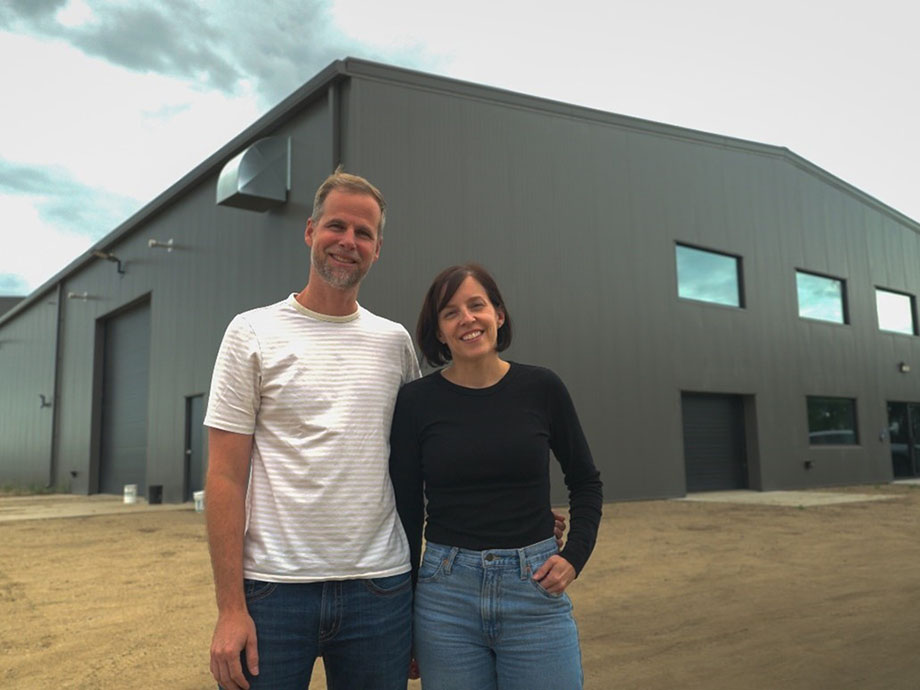
Stuart Rostant and Amanda Doiron’s modular housing factory in Manitoba opened in February 2025. The factory’s first 9 homes were shipped to Nunavut, installed and occupied by November

Ambition meets adventure

Partners in work and life, Stuart grew up in Trinidad and Tobago, and Amanda in New Brunswick. They met at university and moved to Trinidad shortly after graduation.

Two years later, an economic downturn caused them to pivot.

“Work dried up,” says Stuart. “We had bills to pay. We had just purchased a small home. And yeah, Amanda had the crazy idea of going to the Arctic.”

A self-described, “easy-going Caribbean guy,” Stuart said, “Sure, if you get a job let’s go.”

A month later, Amanda had a job as a project officer with Community and Government Services, Government of Nunavut.

“We landed in June of 2010 and the ocean was still frozen,” says Stuart.

“I think that was my first, oh, what have we got ourselves into?”

Shortly after, Stuart also secured a role with Community and Government Services, Government of Nunavut. For the next 6 years, the couple deepened their understanding of the housing needs and challenges of Canada’s North. They also started to explore technologies, techniques and housing solutions, and built themselves a packaged home from a southern supplier.

No middle ground

“The housing continuum is not broad up here like you might see in other places in Canada,” says Vicki Aitaok, manager, Cambridge Bay Housing Association — one of 25 local housing associations working within the directives of Nunavut Housing Corporation (NHC).

Vicki describes the 3 main housing types as income-based public housing, employer-subsidized housing and private market rental housing.

“It's the speed and the energy efficiency and the economic efficiency of it [modular housing] that just makes sense for Nunavut.”
–Vicki Aitaok, manager, Cambridge Bay Housing Association

“We do have shelters and things like that now which we didn’t have maybe 10 years ago,” says Vicki. But “There is no affordable housing. There’s no middle of the ground.”

“People are growing up not understanding that home ownership or affordability is an option,” she explains. “People are 2 to 3 generations with public housing.”

With 185 families on the housing waitlist, demand is high and compounded by overcrowding and aging housing stock.

Solutions through partnerships

In 2022, NHC launched Nunavut 3000, a strategy to create 3000 units by 2030.

“NHC will not build all 3,000 units. Instead, the strategy calls on all housing partners and developers to work collectively towards this expanded number of new units, regardless of whether they are public, affordable, or private market housing.” – Nunavut 3000 (PDF, 7.4 MB)

“Nunavut 3000 is really more than adding real estate,” says Vicki. “It’s the partnerships that are being created. There are opportunities now for small businesses to get in on some of the action. Whether they can build 1 or 10 units. It all counts.”

“Partnerships are very important for us, and they have been since probably the first day that we started doing projects in the North.”
–Amanda Doiron, founder, Arctic Modular Homes

That same year, Stuart and Amanda applied for CMHC’s Northern Housing Supply Challenge.

“It was tailored directly to us… They were looking at Northern supply challenges. And we thought that you know, if we got some funding behind us, we can really make a huge difference at a different scale than what we are currently doing,” says Stuart.

Stick build versus modular

Over the course of 10 years, Amanda and Stuart built a variety of projects with different construction methods and reached several conclusions.

“At the end of the day, you can build a beautiful product, but if no one can afford it, then it just sits there empty... And building in the north is really expensive.”

With the traditional stick build method, raw materials are shipped in and assembled on site.

“You’re bringing material up. It’s all packaged, it’s loose,” says Stuart. “And most of that material is going to go through a winter, that cycle of sitting in snow. There’s no warm storage.” Also, “In most communities they don’t have hardware stores. So, you miss something or need something or something gets damaged, your replacement costs flying that stuff in... There’s a huge cost.”

Stick build also requires large crews. Some may need to be flown in. All need accommodation. Overall, it can take months and prove costly.
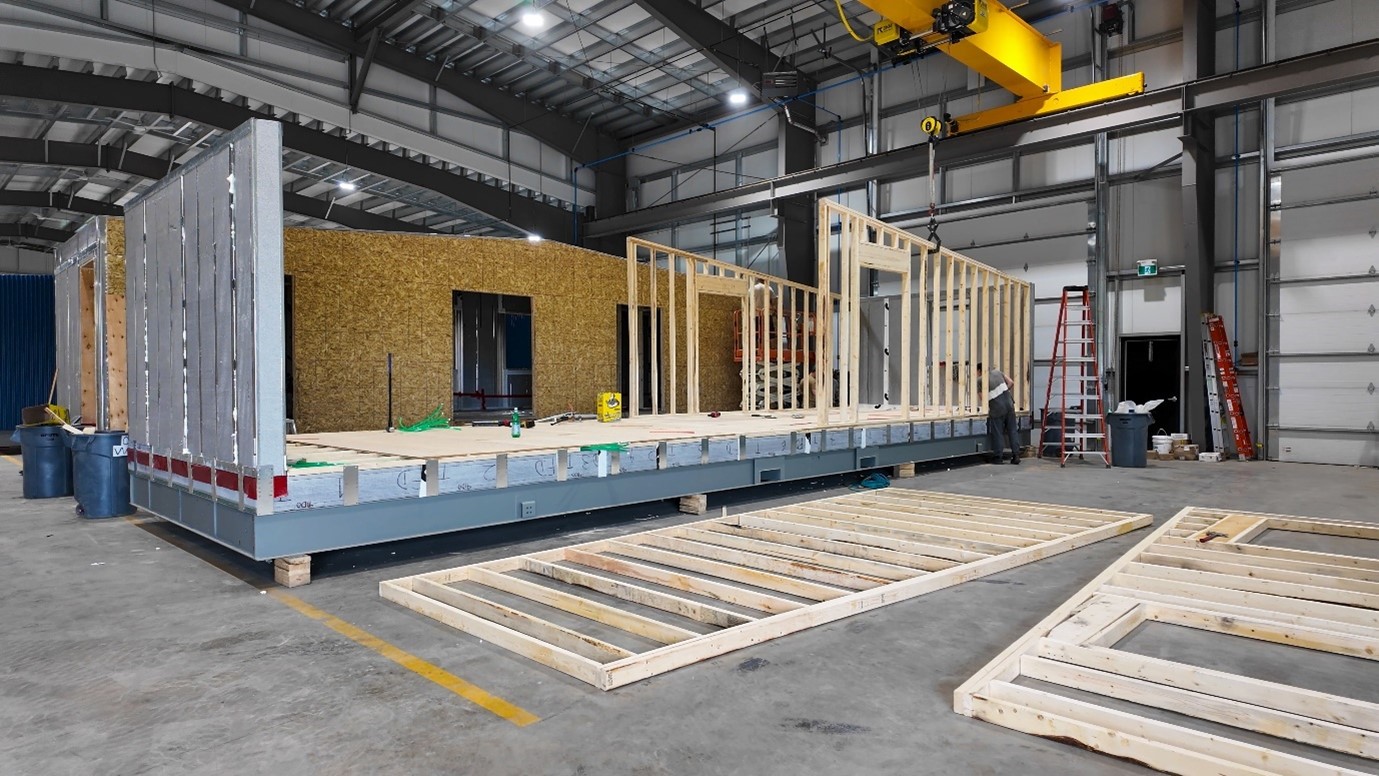
Station 1 in the factory where walls, floors and roofs are installed.

With modular, homes are built off site, transported and installed in days with a relatively small crew.

Amanda and Stuart determined that the per square foot cost of stick build and modular is similar. However, when time and risk are factored in, modular wins out.

“It's the speed and the energy efficiency and the economic efficiency of it that just makes sense for Nunavut,” Vicki adds.

By the time they launched Arctic Modular Homes, Stuart and Amanda were building a modular home a year and exploring how to scale production. The Northern climate, limited access to materials, resources and personnel meant they had to look further afield.

“I think we would have gotten here at some point, but it probably would have taken us 10 years versus one year.”
–Stuart Rostant, founder, Arctic Modular Homes

During their time with Community and Government Services, Amanda and Stuart established relationships with suppliers, contractors and electrical and mechanical teams in Winkler, Manitoba. All were proficient in the Northern climate. Building a climate-controlled factory in Manitoba would enable them to build year-round and then ship homes to the North during the July-September sailing season.

“And with Winkler’s location central to Canada, there was the idea of further down the road if we want to actually start shipping from Churchill or if we were to ship from Vancouver, then our transportation is central to Canada,” says Amanda.

Off to the races

Arctic Modular Homes’ Housing Supply Challenge proposal was a success and construction of the factory started in 2024.

“I think we would have gotten here at some point,” says Stuart, “but it probably would have taken us 10 years versus one year.”

By February 2025 they were in production on their first order.

“We landed a contract with Nunavut Housing to produce 9 homes, approximately 11,000 square feet, 22 pods within a 4 or 5-month period,” says Stuart. “It was really off to the races.”

To design the factory workflow, Stuart and Amanda collaborated with the National Research Council and the University of New Brunswick. While the initial concept has evolved based on the realities experienced on the floor, the basic workflow remains — 6 pods flow through a series of 5 workstations. 
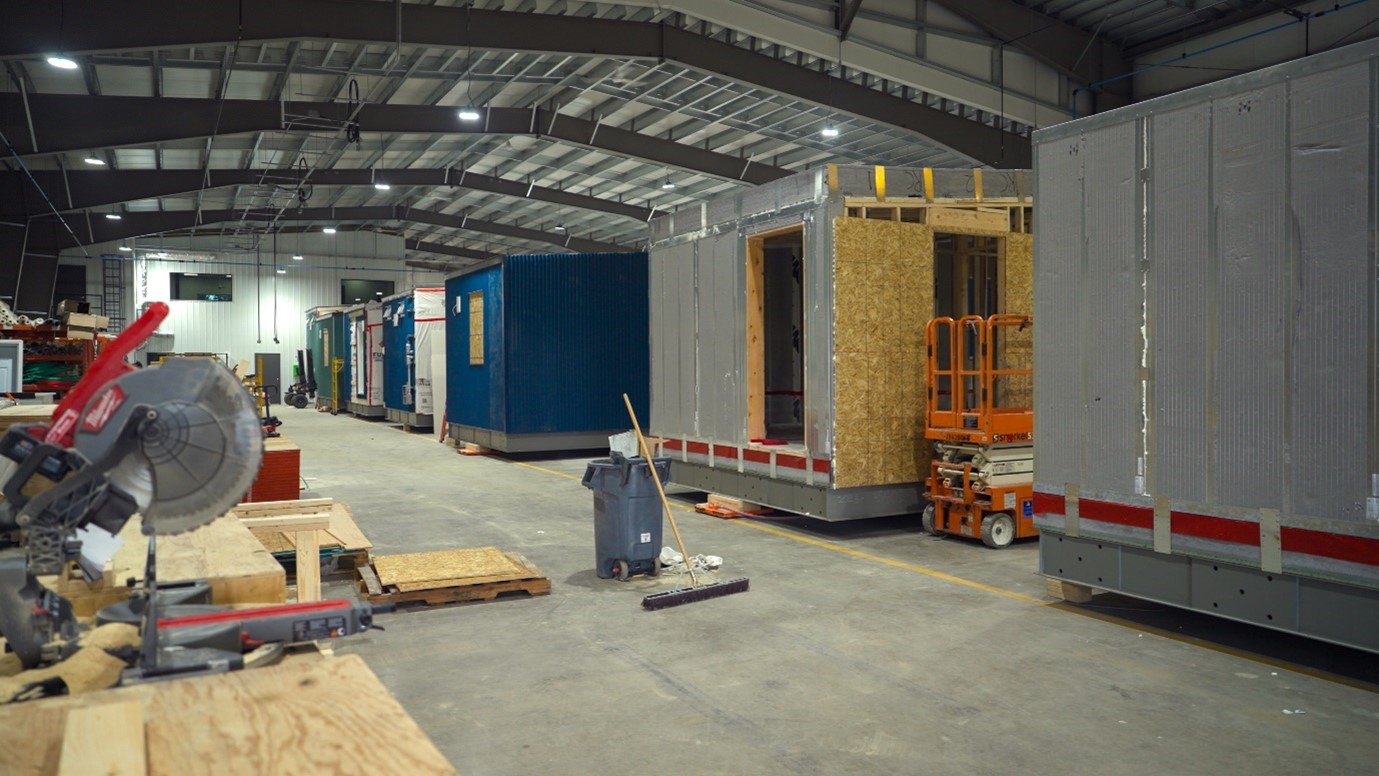
Pods move through a series of workstations in the factory (right to left.)
  • Station 1: Walls, floors and roof assembled.
  • Station 2: Mechanical, electrical and drywall installed.
  • Station 3: Mudding, taping.
  • Station 3b: Painting.
  • Station 4: Kitchens, cabinetry, backsplash, tile work and baseboards.
  • Station 5: Overflow, electrical finishing.

Finished pods are stored on site until they are transported to Montréal.
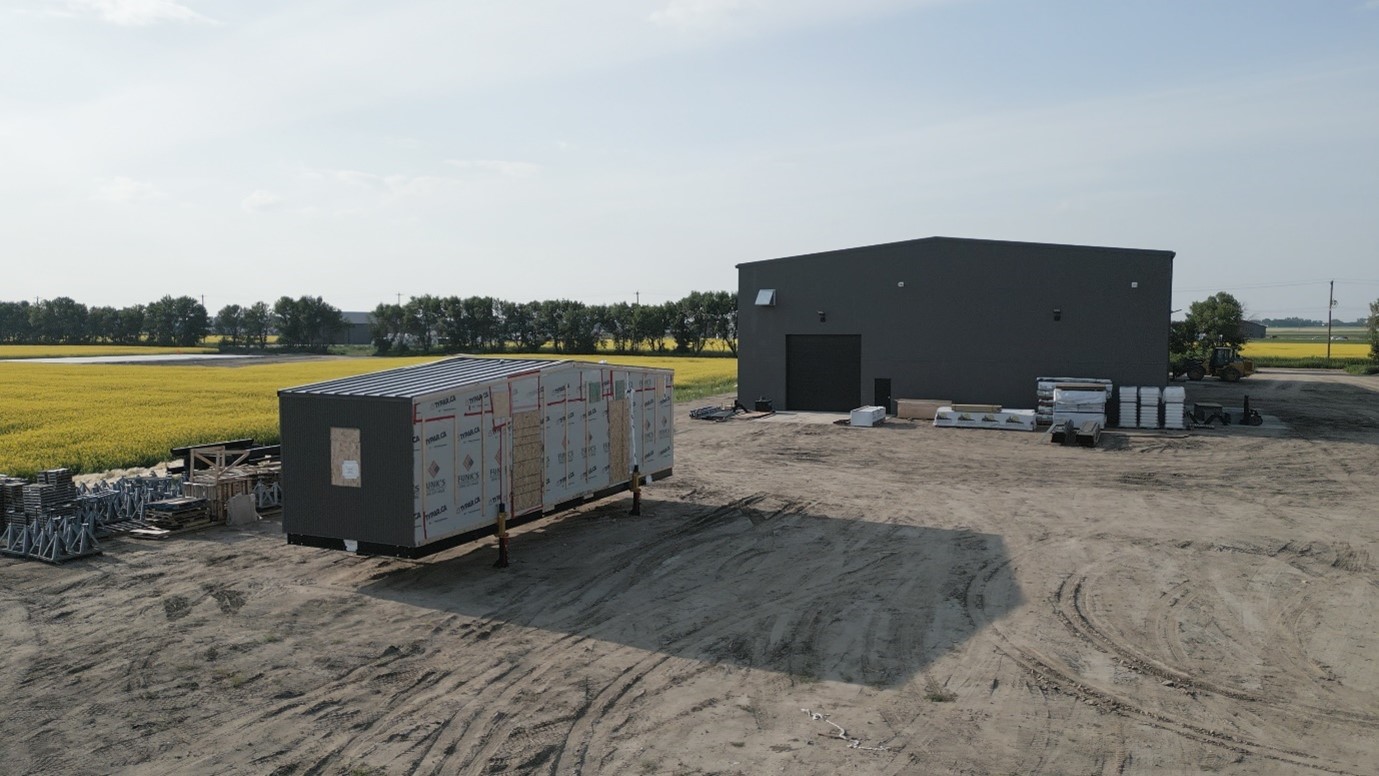
A pod waits to be transported from Winkler to the Port of Montréal.

The long journey home

At the end of July, the final pods left Winkler for the Port of Montréal. By mid-August, all 22 pods were loaded and stacked onto the ship for the 11-day 5,000 km journey to Cambridge Bay. 
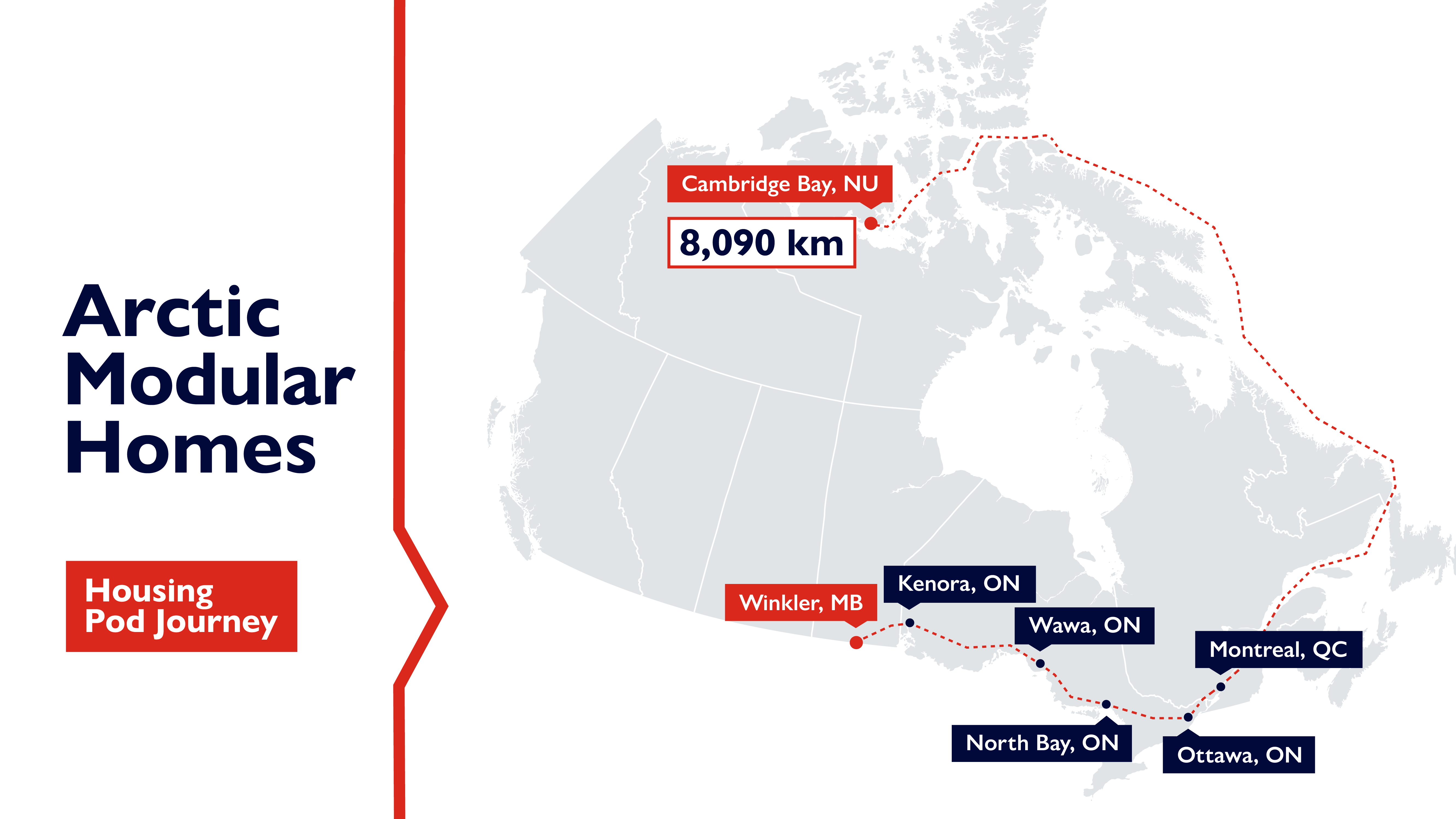
Pods are transported from Arctic Modular Homes’ factory in Winkler to Montréal, where they are loaded onto a ship and transported to Cambridge Bay.

The arrival of the pods in Cambridge Bay was quickly followed by the installation crew, many of whom assembled the homes in Winkler.

Nine weeks later, the pods were installed and operational. Two weeks after that, 9 families received the keys to their homes.

“When we can actually allocate or move people into units, that's the best part of my job,” says Vicki.

On a frosty November day, together with Stuart and Amanda, Vicki watched as the new residents entered their new homes for the first time.

“That's when it makes it all worthwhile. You see hope, you see happiness. You see a future in people's eyes. Like it's just, yeah, everybody cries when they get a house. It's, it's wonderful.”

“My hope, vision that I have that keeps me going would be that there might be 10 to 15 people in a housing list in the north,” says Amanda. “That, for me, would mean that we did a good job.”

The path forward

Already in production for 2026, Amanda and Stuart are keen to expand and deliver to more communities across Nunavut and Canada. They would also like to train Northern crews in the factory to build capacity for modular construction in the North.

At the end of the day, they want to increase options for people at all points on the housing continuum.

“I think both Stuart and I, when we moved to Nunavut that first year, you're trying to find yourself. It's a different terrain, landscape, people, weather and it's a very soul-searching moment where [you ask yourself] what am I doing? What do I want to be doing?” says Amanda.

“Jumping into building our home and having people come to our home… seeing how they were interested in and excited about, like, ‘I would love to have a house like this. I would love to own my own home’ has been the driving force for us since day one… There's nothing like it.” 


KEY FACTS

  • Arctic Modular Homes’ production facility in Winkler, Manitoba was supported by the Housing Supply Challenge: Northern Access Round.
  • The Housing Supply Challenge was a 5-year initiative led by CMHC and Impact Canada that rewarded a diverse portfolio of solutions to break down barriers to housing supply and affordability. Citizens, stakeholders and experts participated in 5 distinct rounds and received funding to prototype and implement their solutions. 
  • More information about the projects and results can be found in the Housing Knowledge Centre. 

We want to hear from you!

Please take this survey and tell us what you think about the success stories on our website. It won’t take more than 3 minutes. Many thanks.

This survey is anonymous. The information collected helps us better understand our audience's preferences.

Take the survey (opens in a new tab) No Thank you

Was this page relevant to your needs?

Thank you for your feedback!

How Can We Help?

What could we improve?

Please select all that apply.
Note: You will not receive a reply. Don't include personal information.

Google Captcha Loader

How Can We Help?

Report a Bug

Please describe the problem.

Google Captcha Loader

Thank you. Your feedback has been submitted.

Date Published: April 24, 2026

Discover related content using the tags below:

  • Funding
  • Success Stories
  • Technology
  • Housing Needs and Conditions
  • Innovation

By Topic

  • Professionals
    • Project funding and mortgage financing
    • Housing markets data and research
    • Industry innovation and leadership
    • Events and speakers
  • Consumers
    • Home buying
    • Owning a home
    • Renting a home

About Us

  • CMHC's Story
  • Management and Governance
  • Our Partners
  • Corporate Reporting
  • Contact Us
  • Careers

More

  • CMHC Housing Updates
  • CMHC Library
  • Housing Observer
  • Media Newsroom
  • CMHC and Accessible Housing
  • CMHC on Twitter
  • CMHC on LinkedIn
  • CMHC on Facebook
  • CMHC on Instagram
  • CMHC on YouTube
Privacy Policy    |    Terms and Conditions    |    Transparency    |    Accessibility Plan    |    Accessibility Feedback     Canada Mortgage and Housing Corporation (CMHC) ©2026 
Canada
loader icon