
 FR
FR
 Sign In



 Done!
Done!





 Link copied
 Share via Email
In June 2022, Canada Mortgage and Housing Corporation (CMHC) released Canada’s Housing Supply Shortages: Estimating what is needed to solve Canada’s housing affordability crisis by 2030 (ESG 2030), which took initial steps to estimate how much additional housing supply is required to restore housing affordability by 2030.
An important challenge to reaching those objectives by 2030 is the amount of skilled labour required. Using the housing supply targets outlined in ESG 2030, CMHC has released the follow-up report Labour Capacity Constraints and Supply Across Large Provinces in Canada, which examines the skilled labour capacity in Ontario, Quebec, BC and Alberta, to deliver on this level of needed housing supply.
The report looks at a best-case scenario, which projects housing starts with ‘maximum’ labour capacity and compares these projections to the affordability supply targets set out in ESG 2030 and CMHC baseline starts forecasts. The best-case scenario is based on the highest percentage of people in our population who work in residential construction and the lowest number of residential construction workers per housing unit under construction in the past 25 years.
The report finds that under best-case scenarios, housing starts will fall well below the 2030 affordable supply targets in Ontario, BC and Quebec, while Alberta will be able to achieve its affordable housing supply target by 2030.
This report further reinforces that to solve the issue of housing affordability in Canada, we need an ‘all-hands-on-deck’ approach to increasing the supply of housing to meet demand. This will include building on innovative ideas and initiatives being utilized in the current housing industry and through the federal government’s National Housing Strategy, as outlined in the Proposed Solutions section below.
Housing supply affordability targets versus best-case housing starts projections (2022-2030):
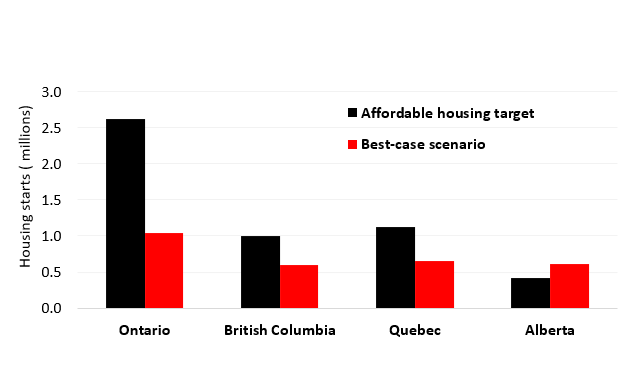
Source: Provincial authorities, Statistics Canada, CMHC
| Affordable Target | Best Case Scenario | |
|---|---|---|
| Ontario | 2,617,449 | 1,045,159 |
| British Columbia | 993,450 | 598,459 |
| Quebec | 1,124,344 | 649,206 |
| Alberta | 418,272 | 612,501 |
Report key findings:
- At this current pace, there is insufficient labour capacity to address the significant housing supply gaps, mainly in Ontario and British Columbia (BC).
- Under a best-case scenario, labour capacity exists only to increase housing starts activity across all four major provinces between 2022 – 2030 by an annual average of 30% to 50% above CMHC’s baseline housing starts forecasts:
- Ontario by 36%
- Quebec by 29%
- British Columbia by 41%, and
- Alberta by 54%
- Ontario, Quebec & BC need to double their best-case labour capacity in order to adequately reach housing affordability supply targets by 2030.
- Labour capacity issues are most critical in Ontario, which has the largest population and the highest price pressures.
- While the pandemic has shown that the workplace can pivot and manage greater construction volumes with fewer workers, this may still cause construction backlogs, which will create delays and postpone supplying new units to markets in need of more supply.
Proposed solutions:
- The federal government, through CMHC, is creating and rolling out programs, such as the Housing Accelerator Fund and the Rapid Housing Initiative, amongst others, as part of the National Housing Strategy, that aim to identify and address innovative solutions to accelerate the construction of housing supply in many urban centres in Canada.
- Shift focus towards converting existing structures into residential units – particularly existing commercial structures. This method has proved successful through the conversions of hotels, motels, and office space through the Rapid Housing Initiative.
- Increase the construction of multi-unit housing, as it provides less logistical constraints of moving labour materials and equipment among structures than single-detached homes.
- Create more incentives to develop a new generation of skilled construction workers.
- More targeted immigration programs to encourage skilled, temporary and/or permanent foreign workers to bridge the labour shortage, particularly in Ontario and BC.
Information on this release:
We encourage journalists to contact CMHC Media Relations and arrange to speak to the report authors for Labour Capacity Constraints and Supply Across Large Provinces in Canada.
Media Relations, CMHC
media@cmhc.ca
Follow us on Twitter, YouTube, LinkedIn, Facebook and Instagram.
Backgrounder:
As a trusted source of housing information, CMHC provides unbiased housing-related data, research and market information to help close knowledge gaps, and deepen understanding of complex housing issues to inform future policy decisions. This is another in a series of reports that we will be publishing in the future to deepen our understanding and close our knowledge gaps on Canada’s housing affordability issues.