
Professionals Consumers Housing Observer About
Skip to content
CMHC Home Canada Mortgage
and Housing Corporation
  • FR
  • Sign in photo Sign In
  • Insurance and Securitization

    • Homeowner and Small Rental Insurance
    • Multi-Unit Insurance
    • Securitization
    • Claims, Defaults and Risk Management

    Tools and Comparison

    • Calculating GDS/TDS
    • CMHC Default Management Tool Selector
    • How to Recognize and Report Mortgage Fraud
    • NHA Approved Lenders

    Housing Programs

    • Apartment Construction Loan Program
    • Housing Accelerator Fund
    • Federal Lands Initiative
    • View all housing programs

    Contact Us

    Contact details for mortgage loan insurance, underwriting, business development and real estate.

    Learn More

    NHA Approved Lenders

    Institutions approved to lend, underwrite and/or administer CMHC-insured loans.

    Learn More
  • Housing Themes

    • Housing Demand and Supply
    • Housing Finance
    • Indigenous Housing
    • Building Innovation
    • Housing Policies and Rules
    • Rental Markets and Vacancy Rates
    • Affordable and Non-Market Housing
    • Housing Needs and Conditions

    Research and Analysis

    • Housing Market Outlook
    • Housing Supply Report
    • Residential Mortgage Industry Report
    • Rental Market Report
    • Northern Housing Report

    Data and Statistics

    • Residential Mortgage Industry Data Dashboard
    • Canadian Housing Survey Data
    • Household Characteristics Data
    • Rental Market Data

    Reports Calendar

    Find out when we’re releasing our latest housing reports.

    Learn More

    Residential Mortgage Industry Report Spring 2026

    Highlighting mortgage trends, lender activity and housing finance insights to support informed decisions for stable, affordable markets.

    Learn More
  • Professionals
  • Consumers
  • Housing Observer
  • About
Housing Finance Solutions
  • Homeowner and Small Rental Insurance
  • Multi-Unit Insurance
  • Securitization
  • Claims, Defaults and Risk Management
  • Calculating GDS/TDS
  • CMHC Default Management Tool Selector
  • How to Recognize and Report Mortgage Fraud
  • NHA Approved Lenders
  • Apartment Construction Loan Program
  • Housing Accelerator Fund
  • Federal Lands Initiative
  • View all housing programs
Housing Expertise
  • Housing Demand and Supply
  • Housing Finance
  • Indigenous Housing
  • Building Innovation
  • Housing Policies and Rules
  • Rental Markets and Vacancy Rates
  • Affordable and Non-Market Housing
  • Housing Needs and Conditions
  • Housing Market Outlook
  • Housing Supply Report
  • Residential Mortgage Industry Report
  • Rental Market Report
  • Northern Housing Report
  • Residential Mortgage Industry Data Dashboard
  • Canadian Housing Survey Data
  • Household Characteristics Data
  • Rental Market Data
FR
  • Solving housing affordability together
  • Canada Housing Research, Data and Insights
  • An International Comparative Study of Catastrophe Risk Mitigation and Insurance
  • Save
  • Share

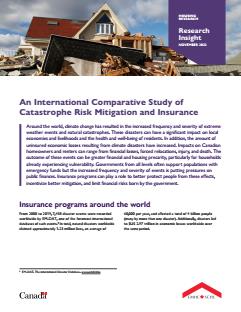
An International Comparative Study of Catastrophe Risk Mitigation and Insurance

PDF - Report

Climate change is resulting in increased frequency and severity of extreme weather events and natural catastrophes around the world. Impacts on Canadian homeowners and renters include:

  • financial losses
  • forced relocations
  • injury and death

Governments from all levels often support populations with emergency funds, but the increased frequency and severity of events are putting pressure on public finances.

Private insurance programs can:

  • play a role in better protecting people from these effects
  • incentivize better mitigation
  • limit government financial risks

We commissioned Deloitte to summarize the results of an international comparative study of government-sponsored and private catastrophe risk mitigation and insurance.

Our report assesses catastrophe risk insurance pools by:

  • structure
  • economic impacts
  • risk mitigation strategies

It analyses catastrophic risk insurance pools from 3 international case studies. The research team chose these examples because their experiences floods and earthquakes are transferable to Canada:

  • the United Kingdom
  • France
  • Japan

Each case study explored:

  • role of government
  • strengths
  • weaknesses
Author:
CMHC
Document Type:
PDF
Date Published:
January 20, 2023
Download

Key findings

Property insurance is an important part of the housing finance system and its health is tied to the health of the entire system. Having a well-designed property insurance system impacts achieving affordable and climate compatible and resilient housing.

The impacts also extend to providing stability to the housing finance system when catastrophic events occur. Industry subject matter experts identified the following 6 features as the most important elements to consider when developing a catastrophe risk insurance pool in Canada.

Role of government and private sector

  • Across the pools analyzed in this research, the private sector provides insurance while the government developer supportive public policies
  • The government may also develop partnerships with private reinsurance companies to lessen financial losses in years with significant climate events.

Administrative ease

Relevant factors include:

  • contracting requirements
  • automatic processing capabilities
  • level of bureaucracy
  • associated decision-making timelines

New technologies such as robotic processing and Artificial Intelligence can help private insurers process claims faster.

Risk exposure

  • Catastrophe risk insurance pools can discourage development in disaster-prone areas through pricing signals.
  • Monitoring performance indicators such as natural disaster mapping and climate change data can also mitigate risk exposure.

Funding mitigation

  • Insurance premiums collected within a catastrophe risk insurance pool can also serve as a source of funding for government disaster risk mitigation investments.
  • Premium and/or deductible discounts associated with resiliency measures can encourage greater uptake of disaster mitigation investment among policyholders.

Take-up rates

  • High take-up rates are key to ensuring the effectiveness of the pool.
  • Insurance companies usually use the Law of Large Numbers to determine appropriate and stable premium rates.
  • If a pool has low take-up rates, the Law of Large Numbers is not as applicable and risks are passed on to individuals and governments.

Risk pooling

  • With risk pooling, both low and high risks are insured, making average premiums more affordable.
  • Risk pooling mechanisms can include automatic enrolment of natural catastrophe insurance within property insurance policies.
international-comparative-study-catastrophe-risk-mitigation-insurance-enpdf

Was this page relevant to your needs?

Thank you for your feedback!

How Can We Help?

What could we improve?

Please select all that apply.
Note: You will not receive a reply. Don't include personal information.

Google Captcha Loader

How Can We Help?

Report a Bug

Please describe the problem.

Google Captcha Loader

Thank you. Your feedback has been submitted.

Save Icon

SAVE TO MY FOLDER

An International Comparative Study of Catastrophe Risk Mitigation and Insurance

SAVE
Close this Window   |   Manage my Folder
Save Icon

SAVE TO MY FOLDER

An International Comparative Study of Catastrophe Risk Mitigation and Insurance

Done Done!
Close this Window   |   Manage my Folder
Share icon

Share via

  • Facebook
  • LinkedIn
  • Mail
  • print
  • CopyLink

SuccessCopyLinkVersionLink copied

Share icon

Share via

  • Facebook
  • LinkedIn
  • Mail
  • print
  • CopyLink

SuccessCopyLinkVersionLink copied

share icon

Mail-blue Share via Email

Did You Know?

You can include an email signature?

Register | Sign In

×
Google Captcha Loader
share icon

Mail-blue Share via Email

Done Done!
Close this window

By Topic

  • Professionals
    • Project funding and mortgage financing
    • Housing markets data and research
    • Industry innovation and leadership
    • Events and speakers
  • Consumers
    • Home buying
    • Owning a home
    • Renting a home

About Us

  • CMHC's Story
  • Management and Governance
  • Our Partners
  • Corporate Reporting
  • Contact Us
  • Careers

More

  • CMHC Housing Updates
  • CMHC Library
  • Housing Observer
  • Media Newsroom
  • CMHC and Accessible Housing
  • CMHC on Twitter
  • CMHC on LinkedIn
  • CMHC on Facebook
  • CMHC on Instagram
  • CMHC on YouTube
Privacy Policy    |    Terms and Conditions    |    Transparency    |    Accessibility Plan    |    Accessibility Feedback     Canada Mortgage and Housing Corporation (CMHC) ©2026 
Canada
loader icon