
Professionals Consumers Housing Observer About
Skip to content
CMHC Home Canada Mortgage
and Housing Corporation
  • FR
  • Sign in photo Sign In
  • Insurance and Securitization

    • Homeowner and Small Rental Insurance
    • Multi-Unit Insurance
    • Securitization
    • Claims, Defaults and Risk Management

    Tools and Comparison

    • Calculating GDS/TDS
    • CMHC Default Management Tool Selector
    • How to Recognize and Report Mortgage Fraud
    • NHA Approved Lenders

    Housing Programs

    • Apartment Construction Loan Program
    • Housing Accelerator Fund
    • Federal Lands Initiative
    • View all housing programs

    Contact Us

    Contact details for mortgage loan insurance, underwriting, business development and real estate.

    Learn More

    NHA Approved Lenders

    Institutions approved to lend, underwrite and/or administer CMHC-insured loans.

    Learn More
  • Housing Themes

    • Housing Demand and Supply
    • Housing Finance
    • Indigenous Housing
    • Building Innovation
    • Housing Policies and Rules
    • Rental Markets and Vacancy Rates
    • Affordable and Non-Market Housing
    • Housing Needs and Conditions

    Research and Analysis

    • Housing Market Outlook
    • Housing Supply Report
    • Residential Mortgage Industry Report
    • Rental Market Report
    • Northern Housing Report

    Data and Statistics

    • Residential Mortgage Industry Data Dashboard
    • Canadian Housing Survey Data
    • Household Characteristics Data
    • Rental Market Data

    Reports Calendar

    Find out when we’re releasing our latest housing reports.

    Learn More

    Residential Mortgage Industry Report Spring 2026

    Highlighting mortgage trends, lender activity and housing finance insights to support informed decisions for stable, affordable markets.

    Learn More
  • Professionals
  • Consumers
  • Housing Observer
  • About
Housing Finance Solutions
  • Homeowner and Small Rental Insurance
  • Multi-Unit Insurance
  • Securitization
  • Claims, Defaults and Risk Management
  • Calculating GDS/TDS
  • CMHC Default Management Tool Selector
  • How to Recognize and Report Mortgage Fraud
  • NHA Approved Lenders
  • Apartment Construction Loan Program
  • Housing Accelerator Fund
  • Federal Lands Initiative
  • View all housing programs
Housing Expertise
  • Housing Demand and Supply
  • Housing Finance
  • Indigenous Housing
  • Building Innovation
  • Housing Policies and Rules
  • Rental Markets and Vacancy Rates
  • Affordable and Non-Market Housing
  • Housing Needs and Conditions
  • Housing Market Outlook
  • Housing Supply Report
  • Residential Mortgage Industry Report
  • Rental Market Report
  • Northern Housing Report
  • Residential Mortgage Industry Data Dashboard
  • Canadian Housing Survey Data
  • Household Characteristics Data
  • Rental Market Data
FR
  • Solving housing affordability together
  • Canada Housing Research, Data and Insights
  • Post-Occupancy Evaluation of Salus Karen’s Place Supportive Housing Project
  • Save
  • Share

Post-Occupancy Evaluation of Salus Karen’s Place Supportive Housing Project

PDF - Report

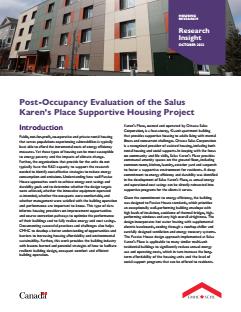
We funded a post-occupancy evaluation of Salus Karen’s Place to better understand how well energy efficiency and emissions reduction performance targets were achieved. Salus Karen’s Place is Canada’s first multi-unit building to achieve Passive House Canada certification.

The building was completed in 2016 and fully occupied in 2017. We funded the initial post-occupancy evaluation in 2018 to 2020, for 2 one-year monitoring periods:

  • January to December 2018
  • January 2019 to January 2020

Following the initial evaluation, further changes were made to the building’s mechanical systems to address on-going cooling issues. We funded an update to the evaluation to measure the impact of these changes, which was done in 2022.

Ottawa Salus Corporation and its design team set out to achieve ambitious energy consumption reduction targets, using the Passive House design approach.

The approach focuses on:

  • a well-performing building envelope with high levels of insulation
  • avoidance of thermal bridges
  • high-performing windows
  • high overall airtightness

The post-occupancy evaluation analyzed:

  • energy use
  • water consumption
  • acoustic and indoor air quality performance

It also benchmarked performance relative to recognized standards, to assess overall occupant satisfaction. In addition, the evaluation identified opportunities for performance improvements.

The design approach used at Salus Karen’s Place is applicable to similar multi-unit residential buildings to significantly reduce annual energy use and operating costs. These savings are reinvested into support programs for residents.

Author:
CMHC
Document Type:
PDF
Date Published:
November 9, 2022
Download

Key findings

Salus Karen’s Place demonstrated high performance in most of the post-occupancy evolution performance areas. There were, however, challenges maintaining thermal comfort during the cooling season. To determine the end-use breakdown of electricity consumption in the building, lighting and key electrical equipment and appliances were inventoried during the evaluation. The results were used to calibrate the building energy model used to determine the end-use profiles.

Envelope performance: The building envelope exceeded the Passive House standard for insulation values. A variety of tests showed that the envelope maintained its integrity over the initial years of building occupancy.

Thermal comfort: Salus Karen’s Place experienced overheating challenges. Steps were taken to remedy the situation through upgrades to the cooling and ventilation systems.

Indoor air quality: Carbon dioxide levels appeared to stay mostly within the targeted range, suggesting that ventilation rates were adequate within the units.

Energy consumption: The project demonstrated an efficient use of energy over the initial years of its occupancy. It came close to meeting its energy use targets and used much less energy than many of the key benchmarks. Starting in 2021 the energy demand increased. This caused the building’s energy use to exceed Passive House standards while staying below the Ontario Building Code (OBC) requirements.

Water consumption: Water consumption was found to be significantly lower than the Canadian average on a per capita basis over the initial years of the building’s occupancy. It was also lower than the area benchmark during this time. Starting in 2021, water consumption also increased.

Implications for the housing industry

This evaluation demonstrates that achieving low energy and/or low emissions is possible in a larger building, even on an affordable housing budget. It also showed that well-insulated, airtight envelopes and low window-to-wall ratios might not be sufficient to prevent overheating. Additional cooling may be needed along with passive cooling strategies. It also showed that commissioning the building’s cooling system at the outset may have mitigated later challenges. The ventilation strategy worked and maintained good indoor air quality and comfort conditions to balance the airtightness of the building.

This evaluation provided an opportunity to assess performance against targets and to find out how performance and costs could be improved. It helped identify potential corrective measures to achieve higher performance and support the reduction of operating costs. This improved affordability for providers and tenants alike.

By regularly conducting post-occupancy evaluations, affordable housing providers can get innovative solutions to long-term planning and affordability.

Related links:

  • Low-energy Buildings – Karen’s Place
post-occupancy-evaluation-salus-karens-place-supportive-housing-project-enpdf

Was this page relevant to your needs?

Thank you for your feedback!

How Can We Help?

What could we improve?

Please select all that apply.
Note: You will not receive a reply. Don't include personal information.

Google Captcha Loader

How Can We Help?

Report a Bug

Please describe the problem.

Google Captcha Loader

Thank you. Your feedback has been submitted.

Save Icon

SAVE TO MY FOLDER

Post-Occupancy Evaluation of Salus Karen’s Place Supportive Housing Project

SAVE
Close this Window   |   Manage my Folder
Save Icon

SAVE TO MY FOLDER

Post-Occupancy Evaluation of Salus Karen’s Place Supportive Housing Project

Done Done!
Close this Window   |   Manage my Folder
Share icon

Share via

  • Facebook
  • LinkedIn
  • Mail
  • print
  • CopyLink

SuccessCopyLinkVersionLink copied

Share icon

Share via

  • Facebook
  • LinkedIn
  • Mail
  • print
  • CopyLink

SuccessCopyLinkVersionLink copied

share icon

Mail-blue Share via Email

Did You Know?

You can include an email signature?

Register | Sign In

×
Google Captcha Loader
share icon

Mail-blue Share via Email

Done Done!
Close this window

By Topic

  • Professionals
    • Project funding and mortgage financing
    • Housing markets data and research
    • Industry innovation and leadership
    • Events and speakers
  • Consumers
    • Home buying
    • Owning a home
    • Renting a home

About Us

  • CMHC's Story
  • Management and Governance
  • Our Partners
  • Corporate Reporting
  • Contact Us
  • Careers

More

  • CMHC Housing Updates
  • CMHC Library
  • Housing Observer
  • Media Newsroom
  • CMHC and Accessible Housing
  • CMHC on Twitter
  • CMHC on LinkedIn
  • CMHC on Facebook
  • CMHC on Instagram
  • CMHC on YouTube
Privacy Policy    |    Terms and Conditions    |    Transparency    |    Accessibility Plan    |    Accessibility Feedback     Canada Mortgage and Housing Corporation (CMHC) ©2026 
Canada
loader icon