
Professionals Consumers Housing Observer About
Skip to content
CMHC Home Canada Mortgage
and Housing Corporation
  • FR
  • Sign in photo Sign In
  • Insurance and Securitization

    • Homeowner and Small Rental Insurance
    • Multi-Unit Insurance
    • Securitization
    • Claims, Defaults and Risk Management

    Tools and Comparison

    • Calculating GDS/TDS
    • CMHC Default Management Tool Selector
    • How to Recognize and Report Mortgage Fraud
    • NHA Approved Lenders

    Housing Programs

    • Apartment Construction Loan Program
    • Housing Accelerator Fund
    • Federal Lands Initiative
    • View all housing programs

    Contact Us

    Contact details for mortgage loan insurance, underwriting, business development and real estate.

    Learn More

    NHA Approved Lenders

    Institutions approved to lend, underwrite and/or administer CMHC-insured loans.

    Learn More
  • Housing Themes

    • Housing Demand and Supply
    • Housing Finance
    • Indigenous Housing
    • Building Innovation
    • Housing Policies and Rules
    • Rental Markets and Vacancy Rates
    • Affordable and Non-Market Housing
    • Housing Needs and Conditions

    Research and Analysis

    • Housing Market Outlook
    • Housing Supply Report
    • Residential Mortgage Industry Report
    • Rental Market Report
    • Northern Housing Report

    Data and Statistics

    • Residential Mortgage Industry Data Dashboard
    • Canadian Housing Survey Data
    • Household Characteristics Data
    • Rental Market Data

    Reports Calendar

    Find out when we’re releasing our latest housing reports.

    Learn More

    Residential Mortgage Industry Report Spring 2026

    Highlighting mortgage trends, lender activity and housing finance insights to support informed decisions for stable, affordable markets.

    Learn More
  • Professionals
  • Consumers
  • Housing Observer
  • About
Housing Finance Solutions
  • Homeowner and Small Rental Insurance
  • Multi-Unit Insurance
  • Securitization
  • Claims, Defaults and Risk Management
  • Calculating GDS/TDS
  • CMHC Default Management Tool Selector
  • How to Recognize and Report Mortgage Fraud
  • NHA Approved Lenders
  • Apartment Construction Loan Program
  • Housing Accelerator Fund
  • Federal Lands Initiative
  • View all housing programs
Housing Expertise
  • Housing Demand and Supply
  • Housing Finance
  • Indigenous Housing
  • Building Innovation
  • Housing Policies and Rules
  • Rental Markets and Vacancy Rates
  • Affordable and Non-Market Housing
  • Housing Needs and Conditions
  • Housing Market Outlook
  • Housing Supply Report
  • Residential Mortgage Industry Report
  • Rental Market Report
  • Northern Housing Report
  • Residential Mortgage Industry Data Dashboard
  • Canadian Housing Survey Data
  • Household Characteristics Data
  • Rental Market Data
FR
  • Solving housing affordability together
  • Canada Housing Research, Data and Insights
  • Healthy Homes Adequacy Standard
  • Save
  • Share

Healthy Homes Adequacy Standard

PDF - Report

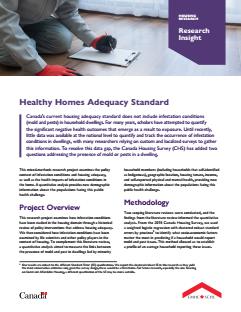
Canada's current housing adequacy standard doesn’t include infestation conditions in dwellings. A better understanding of this issue is important because exposure to mould and pests can cause serious health issues if left unaddressed.

This Research Insight sheds light on infestation conditions by providing quantitative analysis and new demographic information on populations facing this public health challenge.

We examined the historical development of the adequacy standard and how a change in the standard might affect key population groups and their health.

Author:
CMHC
Document Type:
PDF
Date Published:
January 31, 2023
Download

Key findings

  • Renters reported living in dwellings with mould and pests more often than homeowners.
  • Populations that are vulnerable may face additional and complex challenges. They report being exposed more frequently and experience more difficulty dealing with infestation conditions.
  • Self-identified Indigenous households reported more often living in dwellings with mould and pest infestations compared to their non-Indigenous counterparts.
  • Family composition is linked to the presence of mould and pests.

Future research opportunities

  • This research provides results by market home ownership and rental, leaving an opportunity to study infestation conditions in social and affordable housing.
  • Including questions on the presence of mould and pests in future cycles of the Canada Housing Survey provides an opportunity to track changes over time. Infestation conditions could be tracked nationally and provincially.
  • More qualitative research, broken down by tenure and sub-population, would help deepen our understanding of how mould and pest infestations differ between homeowners and renters.

Implications for the housing sector and housing policy

  • There are links between the presence of infestation conditions and physical and mental health outcomes. Addressing mould and pest issues may have more positive impacts on Indigenous households. This is because this group faces complex challenges in accessing adequate housing.
  • The presence of infestation conditions has been linked to more frequent moves by households. Frequent moves may place additional stress on already vulnerable households. Implementing and enforcing acceptability guidelines for the presence of mould and pests in homes could promote healthier living conditions. Such guidelines could be developed to complement and expand on existing national and international guidelines.
  • The current definition of housing adequacy measures the need for major repairs, leaving other elements, like the presence of infestation conditions, unaddressed. There’s an opportunity to update the definition of “adequate” housing. An updated definition could include guidelines on infestation conditions in different housing types and lead to stronger enforcement of healthier home regulations. This definition can be aligned with work related to a Human Rights based approach to Adequate Housing, especially to the standard of physical and mental health.

Sign up to our Housing Research Newsletter to be notified when new insights and other reports are released.

healthy-homes-adequacy-standard-enpdf

Was this page relevant to your needs?

Thank you for your feedback!

How Can We Help?

What could we improve?

Please select all that apply.
Note: You will not receive a reply. Don't include personal information.

Google Captcha Loader

How Can We Help?

Report a Bug

Please describe the problem.

Google Captcha Loader

Thank you. Your feedback has been submitted.

Save Icon

SAVE TO MY FOLDER

Healthy Homes Adequacy Standard

SAVE
Close this Window   |   Manage my Folder
Save Icon

SAVE TO MY FOLDER

Healthy Homes Adequacy Standard

Done Done!
Close this Window   |   Manage my Folder
Share icon

Share via

  • Facebook
  • LinkedIn
  • Mail
  • print
  • CopyLink

SuccessCopyLinkVersionLink copied

Share icon

Share via

  • Facebook
  • LinkedIn
  • Mail
  • print
  • CopyLink

SuccessCopyLinkVersionLink copied

share icon

Mail-blue Share via Email

Did You Know?

You can include an email signature?

Register | Sign In

×
Google Captcha Loader
share icon

Mail-blue Share via Email

Done Done!
Close this window

By Topic

  • Professionals
    • Project funding and mortgage financing
    • Housing markets data and research
    • Industry innovation and leadership
    • Events and speakers
  • Consumers
    • Home buying
    • Owning a home
    • Renting a home

About Us

  • CMHC's Story
  • Management and Governance
  • Our Partners
  • Corporate Reporting
  • Contact Us
  • Careers

More

  • CMHC Housing Updates
  • CMHC Library
  • Housing Observer
  • Media Newsroom
  • CMHC and Accessible Housing
  • CMHC on Twitter
  • CMHC on LinkedIn
  • CMHC on Facebook
  • CMHC on Instagram
  • CMHC on YouTube
Privacy Policy    |    Terms and Conditions    |    Transparency    |    Accessibility Plan    |    Accessibility Feedback     Canada Mortgage and Housing Corporation (CMHC) ©2026 
Canada
loader icon