Professionals Consumers Housing Observer About
Skip to content
CMHC Home Canada Mortgage
and Housing Corporation
  • FR
  • Sign in photo Sign In
  • Insurance and Securitization

    • Homeowner and Small Rental Insurance
    • Multi-Unit Insurance
    • Securitization
    • Claims, Defaults and Risk Management

    Tools and Comparison

    • Calculating GDS/TDS
    • CMHC Default Management Tool Selector
    • How to Recognize and Report Mortgage Fraud
    • NHA Approved Lenders

    Housing Programs

    • Apartment Construction Loan Program
    • Housing Accelerator Fund
    • Federal Lands Initiative
    • View all housing programs

    Contact Us

    Contact details for mortgage loan insurance, underwriting, business development and real estate.

    Learn More

    NHA Approved Lenders

    Institutions approved to lend, underwrite and/or administer CMHC-insured loans.

    Learn More
  • Housing Themes

    • Housing Demand and Supply
    • Housing Finance
    • Indigenous Housing
    • Building Innovation
    • Housing Policies and Rules
    • Rental Markets and Vacancy Rates
    • Affordable and Non-Market Housing
    • Housing Needs and Conditions

    Research and Analysis

    • Housing Market Outlook
    • Housing Supply Report
    • Residential Mortgage Industry Report
    • Rental Market Report
    • Northern Housing Report

    Data and Statistics

    • Residential Mortgage Industry Data Dashboard
    • Canadian Housing Survey Data
    • Household Characteristics Data
    • Rental Market Data

    Reports Calendar

    Find out when we’re releasing our latest housing reports.

    Learn More

    Residential Mortgage Industry Report Spring 2026

    Highlighting mortgage trends, lender activity and housing finance insights to support informed decisions for stable, affordable markets.

    Learn More
  • Professionals
  • Consumers
  • Housing Observer
  • About
Housing Finance Solutions
  • Homeowner and Small Rental Insurance
  • Multi-Unit Insurance
  • Securitization
  • Claims, Defaults and Risk Management
  • Calculating GDS/TDS
  • CMHC Default Management Tool Selector
  • How to Recognize and Report Mortgage Fraud
  • NHA Approved Lenders
  • Apartment Construction Loan Program
  • Housing Accelerator Fund
  • Federal Lands Initiative
  • View all housing programs
Housing Expertise
  • Housing Demand and Supply
  • Housing Finance
  • Indigenous Housing
  • Building Innovation
  • Housing Policies and Rules
  • Rental Markets and Vacancy Rates
  • Affordable and Non-Market Housing
  • Housing Needs and Conditions
  • Housing Market Outlook
  • Housing Supply Report
  • Residential Mortgage Industry Report
  • Rental Market Report
  • Northern Housing Report
  • Residential Mortgage Industry Data Dashboard
  • Canadian Housing Survey Data
  • Household Characteristics Data
  • Rental Market Data
FR
  • Solving housing affordability together
  • Canada Housing Research, Data and Insights
  • House Price and Income Inequality in Canada
  • Save
  • Share

House Price and Income Inequality in Canada

PDF - Report

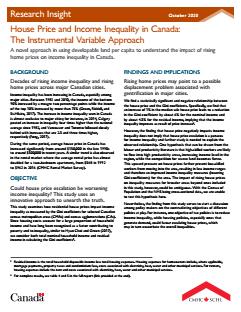
This study examines how residential house prices affects income inequality.

Income inequality has been increasing in Canada almost exclusively in cities. Increases in inequality were posted in 2014 and covered major cities since 1982. They were compared to the national average:

  • Calgary an increase 4 times higher
  • Vancouver an increase 2.5 times higher
  • Toronto an increase 3 times higher

During the same period, average house price in Canada has increased significantly from around $150,000 in the late 1990s to around $500,000 in recent years. The rental market also saw a similar trend. The average rental price almost doubled for a two-bedroom apartment, from $568 in 1992 to $962 in 2016 (CMHC Rental Market Report).

This study uses the Gini coefficients to measure and see if house price escalation could be worsening income inequality. Since housing costs account for a large proportion of household income and both total nominal household income and residual income in calculating the Gini coefficients.


Author:
CMHC
Document Type:
PDF
Date Published:
November 2, 2020
Download
research-insight-house-price-income-inequality-canada-69674-enpdf

Key highlights

Rising home prices may lead to a displacement problem associated with gentrification in major cities.

There is a negative relationship between the house price and the Gini coefficients. We see how an increase of 1% in the median sale house price leads to a reduction in the Gini coefficient. It’s about 6% for the nominal income and about 4.5% for the residual income.

This implies that income inequality improves as result of price increase.

House pricing negatively affecting income inequality doesn’t imply that house price escalation is a catchall solution for income inequality.

We need to research this further to explain the relationship.

One theory is that high-skilled workers are likely to:

  • flow into high productivity areas
  • increase income level in the region
  • generate fierce competition for scarce land

This upward pressure on house prices further prevent low-skilled workers from moving into the area. This results in less income ranges and therefore an improved income inequality measures (lowering Gini coefficients) for the area.

The findings from this study serves to start a discussion among policy makers on the contradicting objectives of different policies at play.

This report is part of the Research Insight series. Read the full report House Price and Income Inequality in Canada: The Instrumental Variable Approach (PDF).

Sign up for our newsletter and we’ll notify you when new research insights are released.

About CMHC Research Insights

Research insights are summaries of our research reports. These insights:

  • identify a housing research issue, gap or need
  • provide an overview of the research project undertaken to address it
  • Present major findings of the research

Examples of research insights topics:

  • adaptability and accessibility
  • affordable housing
  • housing market and finance
Save Icon

SAVE TO MY FOLDER

House Price and Income Inequality in Canada

SAVE
Close this Window   |   Manage my Folder
Save Icon

SAVE TO MY FOLDER

House Price and Income Inequality in Canada

Done Done!
Close this Window   |   Manage my Folder
Share icon

Share via

  • Facebook
  • LinkedIn
  • Mail
  • print
  • CopyLink

SuccessCopyLinkVersionLink copied

Share icon

Share via

  • Facebook
  • LinkedIn
  • Mail
  • print
  • CopyLink

SuccessCopyLinkVersionLink copied

share icon

Mail-blue Share via Email

Did You Know?

You can include an email signature?

Register | Sign In

×
Google Captcha Loader
share icon

Mail-blue Share via Email

Done Done!
Close this window

By Topic

  • Professionals
    • Project funding and mortgage financing
    • Housing markets data and research
    • Industry innovation and leadership
    • Events and speakers
  • Consumers
    • Home buying
    • Owning a home
    • Renting a home

About Us

  • CMHC's Story
  • Management and Governance
  • Our Partners
  • Corporate Reporting
  • Contact Us
  • Careers

More

  • CMHC Housing Updates
  • CMHC Library
  • Housing Observer
  • Media Newsroom
  • CMHC and Accessible Housing
  • CMHC on Twitter
  • CMHC on LinkedIn
  • CMHC on Facebook
  • CMHC on Instagram
  • CMHC on YouTube
Privacy Policy    |    Terms and Conditions    |    Transparency    |    Accessibility Plan    |    Accessibility Feedback     Canada Mortgage and Housing Corporation (CMHC) ©2026 
Canada
loader icon