Professionals Consumers Housing Observer About
Skip to content
CMHC Home Canada Mortgage
and Housing Corporation
  • FR
  • Sign in photo Sign In
  • Insurance and Securitization

    • Homeowner and Small Rental Insurance
    • Multi-Unit Insurance
    • Securitization
    • Claims, Defaults and Risk Management

    Tools and Comparison

    • Calculating GDS/TDS
    • CMHC Default Management Tool Selector
    • How to Recognize and Report Mortgage Fraud
    • NHA Approved Lenders

    Housing Programs

    • Apartment Construction Loan Program
    • Housing Accelerator Fund
    • Federal Lands Initiative
    • View all housing programs

    Contact Us

    Contact details for mortgage loan insurance, underwriting, business development and real estate.

    Learn More

    NHA Approved Lenders

    Institutions approved to lend, underwrite and/or administer CMHC-insured loans.

    Learn More
  • Housing Themes

    • Housing Demand and Supply
    • Housing Finance
    • Indigenous Housing
    • Building Innovation
    • Housing Policies and Rules
    • Rental Markets and Vacancy Rates
    • Affordable and Non-Market Housing
    • Housing Needs and Conditions

    Research and Analysis

    • Housing Market Outlook
    • Housing Supply Report
    • Residential Mortgage Industry Report
    • Rental Market Report
    • Northern Housing Report

    Data and Statistics

    • Residential Mortgage Industry Data Dashboard
    • Canadian Housing Survey Data
    • Household Characteristics Data
    • Rental Market Data

    Reports Calendar

    Find out when we’re releasing our latest housing reports.

    Learn More

    Residential Mortgage Industry Report Spring 2026

    Highlighting mortgage trends, lender activity and housing finance insights to support informed decisions for stable, affordable markets.

    Learn More
  • Professionals
  • Consumers
  • Housing Observer
  • About
Housing Finance Solutions
  • Homeowner and Small Rental Insurance
  • Multi-Unit Insurance
  • Securitization
  • Claims, Defaults and Risk Management
  • Calculating GDS/TDS
  • CMHC Default Management Tool Selector
  • How to Recognize and Report Mortgage Fraud
  • NHA Approved Lenders
  • Apartment Construction Loan Program
  • Housing Accelerator Fund
  • Federal Lands Initiative
  • View all housing programs
Housing Expertise
  • Housing Demand and Supply
  • Housing Finance
  • Indigenous Housing
  • Building Innovation
  • Housing Policies and Rules
  • Rental Markets and Vacancy Rates
  • Affordable and Non-Market Housing
  • Housing Needs and Conditions
  • Housing Market Outlook
  • Housing Supply Report
  • Residential Mortgage Industry Report
  • Rental Market Report
  • Northern Housing Report
  • Residential Mortgage Industry Data Dashboard
  • Canadian Housing Survey Data
  • Household Characteristics Data
  • Rental Market Data
FR
  • Solving housing affordability together
  • Canada Housing Research, Data and Insights
  • Supply Constraints increased prices of apartment condos in Canadian Cities
  • Save
  • Share

Supply Constraints increased prices of apartment condos in Canadian Cities

PDF - Report

This report looks at if supply constraints increases prices of apartment condominiums in major Canadian cities.

Housing affordability concerns have risen in some major Canadian cities since the end of the U.S financial crisis. However, unaffordable housing itself is not a market failure. When the price of housing is similar to the cost of production, or the marginal cost, the market is working properly. If the house price and marginal cost are similar, housing prices won’t decrease by adding more supply. If prices are above the cost to provide additional units, the market has failed.

Market failure has several possible causes:

  • supply constraints
  • regulatory and non-regulatory
  • lack of competition

To set apart these major causes, the analysis must establish whether suppliers can respond to higher prices by building more units. If they cannot, then it is apparent they are constrained in some way.

Author:
CMHC
Document Type:
PDF
Date Published:
December 17, 2018
Download
research-insight-supply-constraints-increased-prices-ca-cities-69631-enpdf

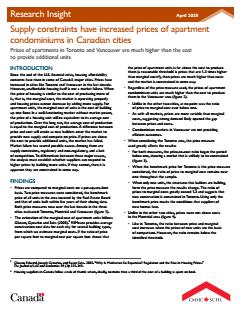
Key highlights in Vancouver, Toronto and Montreal

Prices are compared to marginal costs on a per-square-foot basis. Two price measures were considered:

  • the benchmark price of all units in the area covered by the Real Estate Board
  • the average price of units built within five years of their closing date

Both price measures rose over the last decade in the 3 cities evaluated: Toronto, Montréal and Vancouver.

The marginal cost of producing new apartments unit is far below the average price per square meter that they sell for in Vancouver and Toronto. This is not the case for Montreal as a whole. Individual municipalities within a larger metropolitan area may have different approaches to development and different geography, which may affect how constrained construction is.

Vancouver highlights show much higher pricing for units compared to the cost to produce them:

  • The prices of apartment condominium units are much higher than the cost to produce them.
  • Unlike in the other 2 cities, at no point was the ratio of price to marginal cost ever below one.
  • Strong demand likely opened the gap between prices and costs.
  • Condominium markets in Vancouver are not providing efficient outcomes.
  • In 2018, the majority of units are in municipalities other than the city of Vancouver, specifically in Burnaby and Richmond. Municipalities near the centre of Vancouver have price-to-marginal cost ratios close to that for the overall Vancouver area.

Toronto shows prices measured greatly affected the results:

  • In Toronto the price measure used greatly affects the results.
  • Both measures showed that the market is unlikely to be constrained at the beginning of the time period evaluated.
  • When the benchmark price is the price measure considered, the ratio of price to marginal cost remains near one throughout the sample.
  • When only new units, the structures that builders are building, form the price measure the results change. The ratio of prices to marginal costs greatly exceed 1.3 and suggests that new construction is constrained in Toronto. Using only the benchmark price masks the conditions that suppliers of new homes face.
  • The vast majority of condominium units built within the last five years in the Toronto census metropolitan area (CMA) were in the city of Toronto. Thus, there was no analysis of the census subdivisions performed for Toronto.

Montreal highlights that prices weren’t above costs:

  • Prices were not above costs in the Montreal area.
  • Like in Toronto, the ratio between price and marginal cost increases when the prices of new units are the basis of comparison. However, the ratio remains below the identified threshold.
  • The city of Montreal itself has a ratio of price to marginal cost above 1.3, while other municipalities off the main island, like Laval, do not. Increased sprawl and higher prices in the central city suggest that Montreal’s height limit may be constraining.

To determine if we have observed constraints on supply, we must determine if builders can react to changes in demand indicated by increasing prices. If a supply constraint prevents builders from responding to higher prices with more units, we would expect little relationship between past prices and current apartment starts.

  • There is no statistically significant relationship between apartment starts and past prices in the Toronto or Vancouver areas.
  • Such a relationship exists in Montreal, the area analyzed that shows no evidence of constrained supply

This suggests that supply constraints have muted supply responses in Vancouver and Toronto. Price frictions in Toronto and Vancouver are low compared to those observed in cities in the U.S., Australia and New Zealand.

This report is part of the Research Insight series. Read the full report Supply constraints have increased prices of apartment condominiums in Canadian cities.

Sign up for our newsletter and let us notify you when new research insights are released.

About CMHC Research Insights

Research insights are summaries of our research reports. These insights:

  • identify a housing research issue, gap or need
  • provide an overview of the research project undertaken to address it
  • Present major findings of the research

Examples of research insights topics:

  • adaptability and accessibility
  • affordable housing
  • housing market and finance
Save Icon

SAVE TO MY FOLDER

Supply Constraints increased prices of apartment condos in Canadian Cities

SAVE
Close this Window   |   Manage my Folder
Save Icon

SAVE TO MY FOLDER

Supply Constraints increased prices of apartment condos in Canadian Cities

Done Done!
Close this Window   |   Manage my Folder
Share icon

Share via

  • Facebook
  • LinkedIn
  • Mail
  • print
  • CopyLink

SuccessCopyLinkVersionLink copied

Share icon

Share via

  • Facebook
  • LinkedIn
  • Mail
  • print
  • CopyLink

SuccessCopyLinkVersionLink copied

share icon

Mail-blue Share via Email

Did You Know?

You can include an email signature?

Register | Sign In

×
Google Captcha Loader
share icon

Mail-blue Share via Email

Done Done!
Close this window

By Topic

  • Professionals
    • Project funding and mortgage financing
    • Housing markets data and research
    • Industry innovation and leadership
    • Events and speakers
  • Consumers
    • Home buying
    • Owning a home
    • Renting a home

About Us

  • CMHC's Story
  • Management and Governance
  • Our Partners
  • Corporate Reporting
  • Contact Us
  • Careers

More

  • CMHC Housing Updates
  • CMHC Library
  • Housing Observer
  • Media Newsroom
  • CMHC and Accessible Housing
  • CMHC on Twitter
  • CMHC on LinkedIn
  • CMHC on Facebook
  • CMHC on Instagram
  • CMHC on YouTube
Privacy Policy    |    Terms and Conditions    |    Transparency    |    Accessibility Plan    |    Accessibility Feedback     Canada Mortgage and Housing Corporation (CMHC) ©2026 
Canada
loader icon