Professionals Consumers Housing Observer About
Skip to content
CMHC Home Canada Mortgage
and Housing Corporation
  • FR
  • Sign in photo Sign In
  • Professionals
  • Consumers
  • Housing Observer
  • About
FR
  • The Housing Observer
  • Rising rates on homeowners and the shocks that lie ahead
  • Save
  • Share
Tania Bourassa-Ochoa — Senior Specialist of Housing Research

Tania Bourassa-Ochoa — Senior Specialist of Housing Research

Rising rates on homeowners and the shocks that lie ahead

November 9, 2023

Homeowners had gotten used to low interest rates. While mortgage rates around 6 to 7% have been common in Canadian financial history, the mortgage holders of today are facing the fastest and largest increase in interest rates to this level in over 4 decades. This steep interest rate hike is coinciding with a time when households are facing historically high levels of debt and higher cost of living.

As high inflation persists, a higher-for-longer interest rate environment might be emerging. This raises questions around the:

  • growing financial pressure on mortgage holders, and
  • the impact that their resulting decisions could have on the overall economy.

In a context where mortgage holders will be paying higher interest rates for a longer period, housing affordability remains an issue. These borrowers may find themselves in more precarious financial situations. As a result, these larger mortgage payments are making the Canadian economy more susceptible to negative shocks or downturns.

Many mortgage consumers have already experienced the effects of higher rates. In fact, since the beginning of the rate hike in March 2022, 1 out of 3 borrowers have gradually seen their monthly mortgage payment increase. This is particularly true for those who have a variable rate term on their mortgage loan.

Additionally, in the first half of 2023, more than 290,000 mortgage borrowers renewed their mortgage with a chartered bank at a higher interest rate: from 5.45% for a 5-year fixed rate to 7.38% for a variable rate.

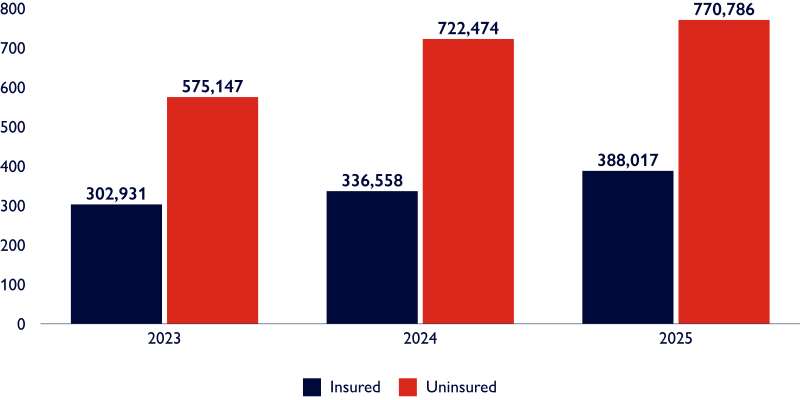
In 2024 and 2025, an estimated 2.2 million mortgages will be facing interest rate shock, representing 45% of all outstanding mortgages in Canada. Most of these borrowers contracted their fixed-rate mortgages at record-low interest rates and, most likely, at or near the peak of housing prices around 2020 – 2021. This holds true for both households who took out a mortgage when buying their new home. It also applies to the numerous existing homeowners that used the increased equity on their property by refinancing and taking cash out for consumption.

The total amount of mortgage loans to be renewed during this period represents over $675 billion, which represents close to 40% of the Canadian economy (2022 Gross Domestic Product).

Number of Mortgages Facing Renewal at Higher Rates

Sources: Statistics Canada. Table 10-10-0006-01 Funds advanced, outstanding balances, and interest rates for new and existing lending, Bank of Canada

Text Version

Insured Uninsured
2023 302,931 575,146
2024 336,558 722,473
2025 388,017 770,786

The increase in rates equals an additional $15 billion in payments for homeowners every year

As households renew in the coming years, they are expected to see an increase in payments. This increase could represent an uptick of between 30% to 40% in their average monthly payment. However, homeowners will do what they can to continue making their mortgage payments on time. Canadian borrowers tend to prioritize their mortgage payment over all other debt payments and consumption choices.

The increase in interest rates represents an additional estimated $15 billion that homeowners will have to disburse every year to ensure their monthly mortgage payments are made on time.

As a practical example: for a $500,000 mortgage with a five-year fixed-rate term and 25-year amortization, an interest rate increase from 1.94% to 5.45%, which would lead to nearly a $1,000 increase to the monthly payment.

Interest Rate Monthly Payment Increase
1.94% $0 (baseline)
5.45% $950

Available options for Homeowners

As homeowners experience changes to their financial situations, they will typically face a variety of options to try to make ends meet. These can include:

  • choosing new mortgage loan terms that reduce debt-servicing costs, such as longer amortizations (see Residential Mortgage Industry Report — Fall 2023 report)
  • cutting back on savings
  • reducing the consumption of non-essential goods and services
  • delaying major purchases
  • preemptively selling their property
  • prioritizing mortgage payments over those for other credit products such as credit cards, auto loans, or lines of credit

Ultimately, the additional $15 billion in mortgage payments will have to be reallocated from other sectors of the economy, including consumption and investments.

While Canadians find creative ways to make ends meet, further interest rate increases could mean additional pressure on households that are already struggling. Even if mortgage arrears remain stable at record-low levels, other delinquency indicators show an increasing share of Canadians struggling with their debt payments. This indicates that there may be broader financial strain on households. This is evident beyond just mortgage arrears and has implications for the overall financial health of individuals and families.

When looking into other debt payments, the increasing arrears suggest that financial stresses are intensifying for more households. In fact, delinquency rates of 90 or more days have increased in the past year for credit cards (+0.24%), auto loans (+0.22%), lines of credit (+0.16%) and home equity lines of credit (HELOCs) (+4%) (see Residential Mortgage Industry Report — Fall 2023 report)

According to CMHC’s 2023 Mortgage Consumer Survey, half of mortgage holders directly impacted by increased debt-servicing costs face difficulties maintaining certain payments, including mortgage payments. This jumps to 74% when including those who anticipate being impacted in the year to come.

Join Tania Bourassa-Ochoa for an in-depth discussion of the reports findings. Watch the videoJoin Tania Bourassa-Ochoa for an in-depth discussion of the reports findings. Watch the Video

CMHC is well positioned to sustain potential mortgage defaults

Default insurance is mandatory for mortgages where the borrower’s down payment is less than 20% of the purchase price. It provides lenders with insurance against borrower defaults while allowing borrowers with smaller down payments to obtain mortgage loans at competitive interest rates. Reduced risk ensures the availability of mortgage funding to homebuyers with lower levels of equity during an economic downturn, as the availability of mortgage credit is often reduced. This provides added stability to housing and financial markets.

The total mortgage insurance space has reached a record low in 2023. In fact, CMHC currently insures around 6.5% of all residential mortgages in Canada, and both arrears and claims remain at historical lows. In this context, CMHC’s exposure to renewal risk remains low.

Most of the risk associated with an interest rate shock lies in the uninsured space. Roughly 75% of residential mortgages in Canada are uninsured; a much higher proportion than in 2016, when only 45% of mortgages were uninsured. This shifting trend was partially caused by a sequence of regulatory changes, many that tightened mortgage insurance eligibility rules. Additionally, with high housing prices in many markets over the past decade, more properties are now near or above the allowed insurable limit of $1 million.

As Canadians face high levels of mortgage debt, additional financial pressures will weigh heavily on homeowners in the years to come. While they will continue to make the available choices to ensure they make their payments, overstretched borrowers are at greater risk of default. This risk is particularly pronounced in a slower economy.

Was this page relevant to your needs?

Thank you for your feedback!

How Can We Help?

What could we improve?

Please select all that apply.
Note: You will not receive a reply. Don't include personal information.

Google Captcha Loader

How Can We Help?

Report a Bug

Please describe the problem.

Google Captcha Loader

Thank you. Your feedback has been submitted.

Discover related content using the tags below:

  • Mortgage Insights
  • Homeownership
  • Housing Market
  • Financing
Date Published: November 9, 2023
Save Icon

SAVE TO MY FOLDER

Rising rates on homeowners and the shocks that lie ahead

SAVE
Close this Window   |   Manage my Folder
Save Icon

SAVE TO MY FOLDER

Rising rates on homeowners and the shocks that lie ahead

Done Done!
Close this Window   |   Manage my Folder
Share icon

Share via

  • Facebook
  • LinkedIn
  • Mail
  • print
  • CopyLink

SuccessCopyLinkVersionLink copied

Share icon

Share via

  • Facebook
  • LinkedIn
  • Mail
  • print
  • CopyLink

SuccessCopyLinkVersionLink copied

share icon

Mail-blue Share via Email

Did You Know?

You can include an email signature?

Register | Sign In

×
Google Captcha Loader
share icon

Mail-blue Share via Email

Done Done!
Close this window

By Topic

  • Professionals
    • Project funding and mortgage financing
    • Housing markets data and research
    • Industry innovation and leadership
    • Events and speakers
  • Consumers
    • Home buying
    • Owning a home
    • Renting a home

About Us

  • CMHC's Story
  • Management and Governance
  • Our Partners
  • Corporate Reporting
  • Contact Us
  • Careers

More

  • CMHC Housing Updates
  • CMHC Library
  • Housing Observer
  • Media Newsroom
  • CMHC and Accessible Housing
  • CMHC on Twitter
  • CMHC on LinkedIn
  • CMHC on Facebook
  • CMHC on Instagram
  • CMHC on YouTube
Privacy Policy    |    Terms and Conditions    |    Transparency    |    Accessibility Plan    |    Accessibility Feedback     Canada Mortgage and Housing Corporation (CMHC) ©2026 
Canada
loader icon